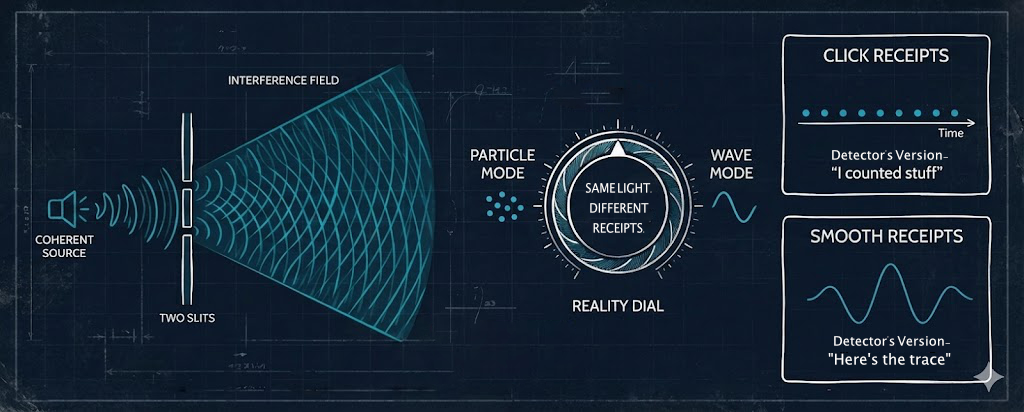
We don't observe the world. We observe the output format of our detectors
Most of us learned quantum mechanics like a bedtime story with a twist ending: dots become fringes, then the fringes “vanish” when you watch. Mind blown. Reality is weird. But that story hides something so obvious; it turns invisible. A detector isn’t a window. It’s a translator. And like any translator, it has opinions.
A “click” is a formatted report: amplified, thresholded, time-binned, and compiled into an event. Change the readout grammar, and you can smoothly morph what the record looks like without changing the source.
We're treating a readout format like gospel
A Geiger counter click, a photon detector ping, a CCD pixel firing; these feel like the cleanest facts in physics. The receipts of reality. A click says: something happened, right there. So we treat the click like bedrock (the atom of truth) and build our stories on top of it.
But get real: what is a click, physically?
It’s not a tiny particle knocking politely on a door. It’s a macroscopic chain reaction that went through a whole production pipeline:
-
a microscopic interaction
-
amplified (because we’re not psychics)
-
thresholded (because noise is annoying)
-
time-binned (because storage costs money)
-
compressed into an “event” (because who has time for continuous data?)
That’s just engineering. You take messy continuous dynamics and compile them into something you can store in a spreadsheet.
A click is the detector’s summary. That doesn’t make it fake. It makes it formatted.
And here’s the kicker: quantization can still be physical. But what often changes across readout modes is the event-structure of the record, not whether interactions come in quanta. You’re not changing the field. You’re changing the readout, and how the record gets compressed.
The "Particle vs Wave" debate is a red herring
This whole debate often hides a simpler switch: number-like vs phase-like measurement.
Popular explanations skip this: some detectors are naturally sensitive to number (how many quanta arrived). Others are sensitive to phase (the field’s oscillatory structure), but only if you give them a reference.
If you want phase information, you usually have to do something active:
-
introduce a local oscillator (a reference wave)
-
mix it with the signal
-
measure the interference
That’s not metaphysics. It’s just signal processing: the same logic as radios and coherent optical receivers. It’s also how gravitational-wave detectors squeeze more sensitivity out of light.
So the world isn’t presenting you with “particle reality” versus “wave reality.” You’re choosing the measurement grammar.
The argument isn’t about reality. It’s about readout.
-
A number-like measurement produces event-like records. (click, click, click)
-
A phase-like measurement produces trajectory-like records. (a smooth voltage trace)
Same system, different measurement question, different kind of record.
There’s a deeper loop here: the rules of measurement shape the states we can stably report, and the states we keep recovering harden into the rules we call “physics.”
Rules write states, and states write rules.
Once you see that loop, “particle” and “wave” stop looking like competing ontologies and start looking like stable renderings of the same underlying process.
It’s not “which one is real?”
It’s “which compression algorithm are you using?”
There's one experiment that makes this painfully obvious
Imagine an interferometer (Mach–Zehnder style). Don’t change the source. Don’t change the environment. Change one thing: how you read out the output mode.
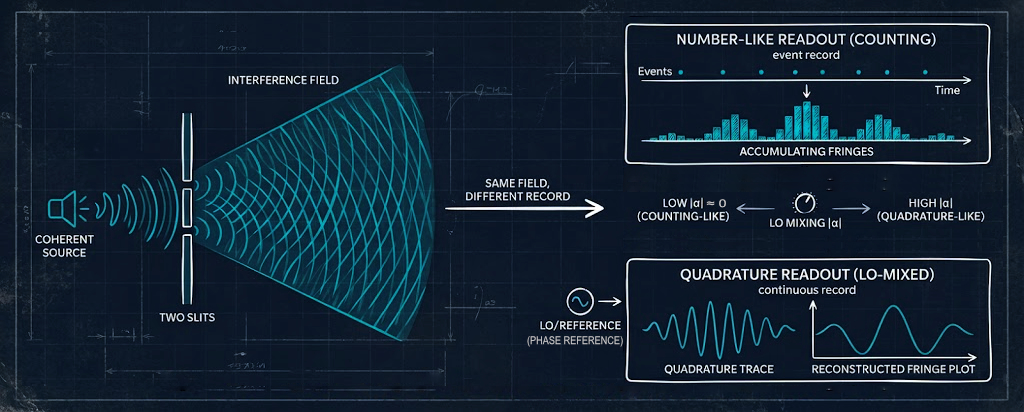
Same field, different record: counting-like clicks vs LO-mixed quadrature readout
You can set it up so the exact same optical field yields either:
-
sparse event counts (“clicks”), or
-
a continuous voltage trace (a quadrature record)
Conceptually, there is a continuous family here: as you mix in a stronger phase reference (local oscillator), the measurement shifts from counting-like toward quadrature-sensitive behavior. In the hybrid MZI version, that interpolation is implemented directly as displaced photon counting on the same output mode, with balanced homodyne used as a calibration cross-check.
But you don’t need two different instruments to do it. You can do it with one smooth control knob: how strongly you mix in a reference field.
Turn the reference way down → “counting-like.” Turn it up → “homodyne-like” continuous readout.
It’s the same setup and the same light, but a different kind of record.
At that point, “is light really a particle or a wave?” starts to feel mis-aimed, because you can dial the record continuously with a knob.
If “particle vs wave” were a fixed property of the thing itself, you wouldn’t be able to morph the record this smoothly by changing only the readout. But you can.
What is a "Particle," then?
Once you can slide between readout regimes, “particle” stops looking like a primitive and starts looking like a mode of reporting.
Here’s a usable definition that doesn’t require mysticism: A particle is not necessarily “what’s out there by default.” It is the name we give to a quantized interaction once a number-like measurement chain has compiled it into an event record.
Quantization can be real. What often changes across readout modes is the event-structure of the record, and which features of the field are preserved, not whether interactions come in quanta.
In many setups, particle-like reports appear when the observer cannot maintain a phase-sensitive lock and falls back to event bookkeeping. It’s not that reality “collapsed”; it’s that your measurement chain chose a number-like grammar under finite information throughput, and the record came out event-coded.
We mistake the log file for the full process.
Why this matters (and why it pisses people off)
It changes what counts as an explanation.
When people say “the universe collapses the wavefunction into a particle,” they’re often using a metaphysical story to explain a data format.
A different framing is possible:
-
the underlying dynamics are what they are
-
the observer is a channel with limited capacity
-
the observer compresses
-
the compression picks a grammar: event stream or trajectory
The “weirdness” doesn’t vanish, but it relocates.
Not: “how can nature be both wave and particle?” But: “why do we treat one detector’s output format as ontological truth?”
This is where it gets spicy. If particles are a measurement regime, then a lot of “quantum weirdness” we’ve been attributing to reality may be artifacts of how we’re reading it out.
That doesn’t make quantum mechanics less interesting. It makes it more interesting because now you’re asking: what’s actually happening, and what’s just the detector talking?
Interpretation arguments often start where instrument design ends.
A practical test, Not a philosophy fight
If you take this seriously, in principle, you can:
-
build a measurement system that can smoothly interpolate between event-like and trajectory-like readouts
-
hold the source fixed
-
define “bandwidth” not as sampling rate, but as information throughput (what you actually learn per second about the parameter you care about)
-
vary the readout and track how the record changes
If the record-type transition is robust, then “particle” isn’t a universal primitive. It’s a regime of observation.
And if you ever find a regime where improving the observer changes not just how much information you get but the rules by which it scales, you’ve found something deeper than interpretation:
a boundary condition of observation itself.
How to stop worrying (and learn to love your detector)
We’ve spent a century arguing about whether reality is discrete or continuous. But the more immediate truth is that our instruments decide which parts of reality become legible.
A click is not the universe speaking. A click is your observer speaking in its native tongue.
And once you can tune that tongue continuously, “particle” stops being an object. It becomes a regime.
Not a regime you choose consciously, necessarily, but one embedded in the design of your measurement apparatus: what information you preserve, what you discard, and what grammar you use to encode the signal.
Once you see that, you can start asking better questions:
-
Not “what is light really?” but “what are the limits of what we can measure?”
-
Not “is reality discrete or continuous?” but “which measurement regimes are stable... and why?”
-
Not “how does the universe collapse wavefunctions?” but “what happens when an observer runs out of resolution?”
These aren’t softer questions. They’re harder. Because they force you to confront the fact that you’re not a passive witness. You’re an active participant in the process of turning signals into facts.
That’s not a bug. That’s a feature.
NEXT :
The ontology and framework behind this lands in the coming days. It’s going to rewire the story we’ve been telling ourselves about what the universe is doing.
And it’s going to be even more annoying.